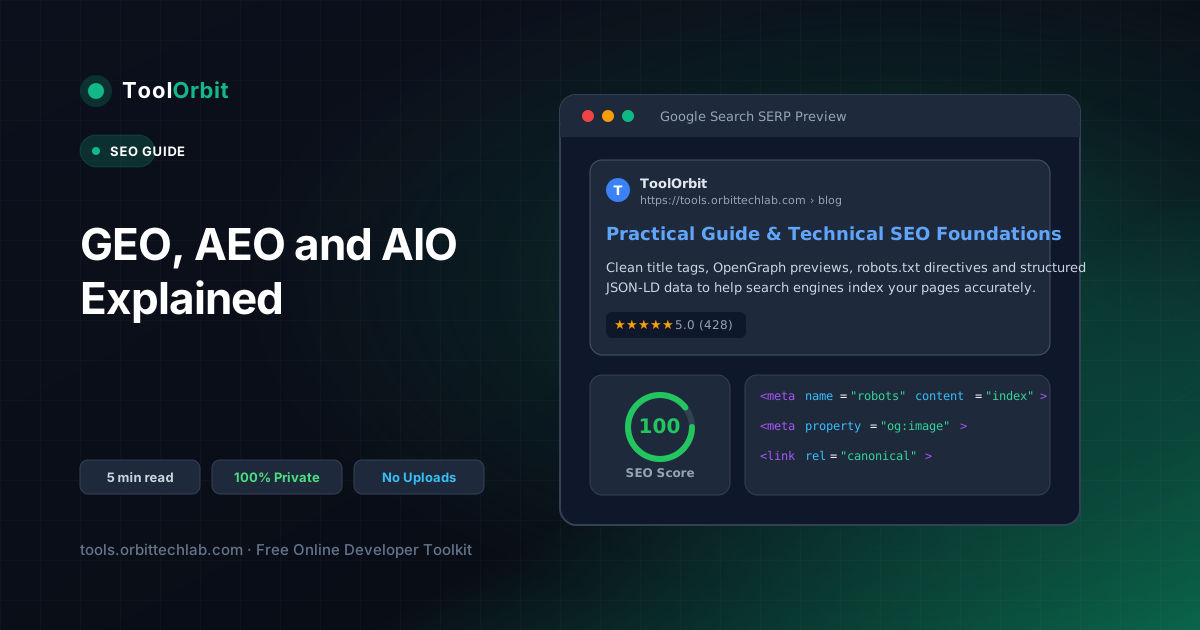
The search landscape is undergoing its most profound transformation since the advent of the web browser. Where search engines once served exclusively as indexes of blue links directing visitors to third-party destinations, modern generative engines synthesize complete answers in real time. Navigating this evolution requires understanding three modern optimization disciplines: Generative Engine Optimization (GEO), Answer Engine Optimization (AEO), and Artificial Intelligence Optimization (AIO).
What is SEO?
Traditional Search Engine Optimization (SEO) focuses on helping search bots crawl your site, parse semantic markup, and index pages for relevant queries. Search algorithms rank these indexed URLs according to relevance, technical performance, and domain authority. The ultimate objective is driving qualified searchers to click through from search engine results pages directly to your website. Our Technical SEO Basics guide covers the foundations every site needs.
What is GEO (Generative Engine Optimization)?
Generative Engine Optimization (GEO) is the practice of tailoring web content so large language models (LLMs) synthesize your information, mention your brand, and link back to your pages as cited sources. Rather than optimizing purely for ranking algorithms that match keywords to user queries, GEO addresses how models ingest text, identify consensus facts, and evaluate topical authority during retrieval-augmented generation (RAG).
Generative engines value factual density, structural clarity, and transparent attribution. When an AI model processes a user prompt, it searches its retrieval index for authoritative passages that directly resolve the inquiry. Pages that provide concise definitions, credible figures, and unambiguous conceptual distinctions are substantially more likely to be selected as grounding context and cited in generative summaries.
What is AEO (Answer Engine Optimization)?
Answer Engine Optimization (AEO) aims to secure placement across zero-click and direct answer surfaces. This encompasses traditional Google featured snippets, voice assistant responses (Siri, Alexa, Google Assistant), and conversational answer engines such as Perplexity, ChatGPT Search, and Microsoft Copilot.
While classic SEO seeks to capture clicks from broad keyword lists, AEO focuses on solving conversational, question-based queries with decisive precision. Answer engines extract discrete passages that resolve user intent without requiring additional exploration. Achieving visibility on these surfaces demands concise question-and-answer pairings, structured tables, and machine-readable data structures.
What is AIO?
Artificial Intelligence Optimization (AIO) is an umbrella term encompassing all optimization practices designed for an AI-mediated internet. Industry practitioners use AIO to describe the convergence of search engine discoverability, generative citations, automated AI agent workflows, and the programmatic consumption of web content by intelligent personal assistants.
Under the AIO framework, webmasters optimize not just for human browsing sessions, but for software agents executing multi-step tasks. This includes publishing machine-readable schemas, exposing markdown endpoints like llms.txt, and structuring transaction flows so autonomous agents can evaluate products, verify specifications, and cite data accurately.
How do they differ?
| Dimension | Traditional SEO | GEO | AEO | AIO |
|---|---|---|---|---|
| Primary Goal | Organic clicks & rankings | AI citations & synthesis | Featured answers & voice | Agent discoverability |
| Primary Surface | Google & Bing blue links | ChatGPT, Perplexity, Overviews | Snippets, Siri, Copilot | AI agents, LLM ecosystems |
| Delivered Output | Ranked list of clickable URLs | Synthesized prose with citations | Single extracted direct answer | Structured knowledge & actions |
| Success Metric | Rankings, impressions, CTR | Citation frequency & share of voice | Snippet wins & zero-click reach | Agent invocation & model recall |
| Key Tactics | Keywords, backlinks, meta tags | Factual density, quotes, entity SEO | FAQ schema, concise QA blocks | Machine-friendly APIs, llms.txt |
A practical checklist for AI search visibility
To make your web properties resilient across generative search systems, implement these ten concrete technical and editorial practices:
- Deploy Comprehensive Schema: Use JSON-LD structured data (Article, WebApplication, FAQPage, Organization) to clarify entity relationships without ambiguity.
- Lead with Answer-First Blocks: Place a direct, 40 to 60 word definition or answer immediately below your primary heading to maximize extraction likelihood.
- Deliver Clean Semantic HTML: Maintain strict heading hierarchies (H1 to H3) and semantic containers so retrieval scrapers isolate relevant passages effortlessly.
- Explicitly Allow AI Crawlers: Configure robots.txt to welcome helpful retrieval user agents including GPTBot, ClaudeBot, PerplexityBot, and OAI-SearchBot. See our Robots.txt Guide for syntax examples.
- Publish llms.txt and llms-full.txt: Provide clean, markdown-formatted site summaries to give LLMs structured directories of your domain content.
- Maximize Factual Density: Replace conversational filler with precise statistics, benchmark findings, technical specifications, and historical dates.
- Format Comparative Data in Tables: Present multi-attribute comparisons in standard HTML tables that language models can parse into structured records.
- Ensure Sub-Second Time to First Byte (TTFB): Optimize server response speeds and caching; AI retrieval bots enforce aggressive timeout thresholds during real-time synthesis.
- Incorporate Authoritative Quotes: Include attributed expert perspectives and proprietary research that generative engines can reference as unique sources.
- Avoid JavaScript-Rendered Critical Text: Ensure core definitions and body text exist in the server-rendered HTML payload, as many retrieval crawlers bypass heavy JS bundles.
What not to expect
It is vital to approach generative optimization with realistic expectations. No legitimate engineering technique guarantees AI citations or consistent model outputs. Generative search engines evaluate queries nondeterministically; two users submitting the exact same question may receive different syntheses and citations.
Furthermore, LLM foundation models and retrieval indexes undergo frequent retraining and algorithm adjustments. Gaining a citation today does not establish permanent prominence. The most sustainable strategy is building verifiable topical authority, maintaining impeccable technical foundations, and publishing accurate, accessible information.
How ToolOrbit tools support this workflow
ToolOrbit provides free, browser-based utilities that solve the core technical prerequisites for AI search discoverability:
- Meta Tag Generator: Generate validated Open Graph, Twitter cards, and canonical metadata to verify entity identity across social and conversational aggregators.
- Robots.txt Generator: Build syntax-checked crawler instructions that grant access to AI retrieval bots while securing private administration directories.
- XML Sitemap Generator: Produce clean, standards-compliant sitemaps with valid lastmod timestamps to ensure fast discovery of newly published articles.
- Keyword Density Checker: Audit text to eliminate repetitive keyword stuffing, verify natural phrasing, and maintain a high ratio of informative terminology.
Frequently asked questions
No. GEO builds upon traditional technical SEO. Generative engines rely on search engine indices and web crawlers to retrieve source documents before synthesizing answers.
AI engines prioritize sources that offer high factual density, clear semantic structure, valid schema markup, fast load times, and demonstrable topical consensus.
Some platforms distinguish between training scrapers and search bots (for instance, GPTBot vs OAI-SearchBot), but directives vary across providers. Check each vendor's documentation.
Answer-first copy provides language models with a self-contained, high-confidence snippet that directly matches the user query, facilitating zero-click extraction and citations.
Tools mentioned
Meta Tag Generator
Generate title, description, Open Graph and Twitter tags.
Robots.txt Generator
Build a valid robots.txt with allow/disallow rules.
XML Sitemap Generator
Turn a list of URLs into a valid XML sitemap for search engines.
Keyword Density Checker
Analyse word frequency and keyword density in any text.